
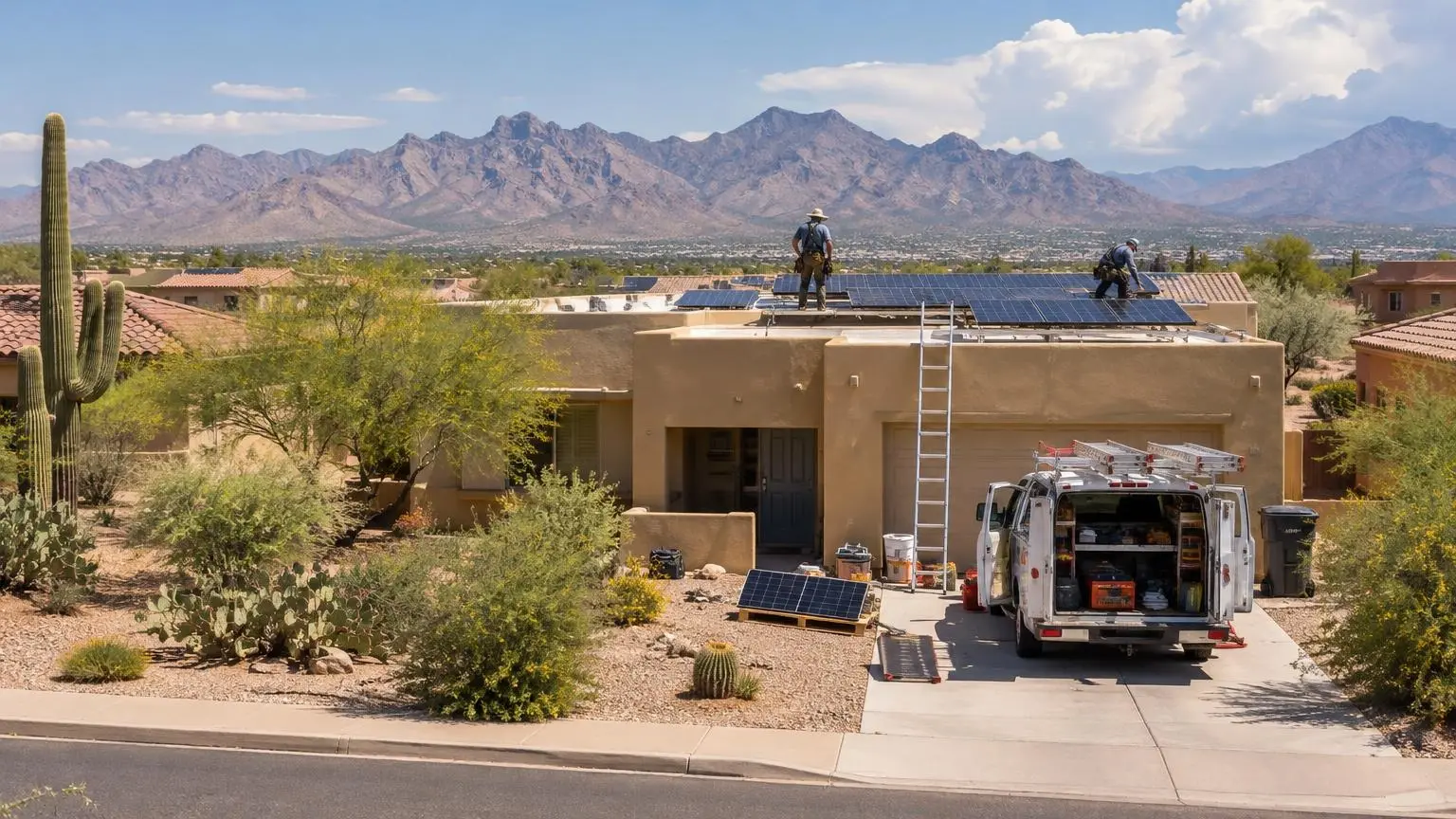
About 158 days a year at 90 degrees or hotter
Solar Panel Repair in Tucson, AZ
Finding out why production dropped, then fixing the panel, wiring, inverter or battery that caused it.
- Free estimate, with the problem traced and explained before any work is priced
- Itemized written quote: parts, labor, roof work and permit fees on separate lines
- Utility paperwork and city or county permits handled where the job requires them
When a Tucson Solar System Stops Pulling Its Weight
Solar panel repair in Tucson usually starts with a number that looks wrong: a monitoring app showing half of last spring's output, an electric bill that crept up, or an inverter screen with a fault code nobody remembers seeing before. Tucson gets roughly 3,806 hours of sunshine a year, about 86 percent of what is possible, so a healthy system here should be producing almost every day. When it is not, there is a reason, and our job is to find it before anyone replaces parts.
Heat is the constant stress
The city averages about 158 days a year at or above 90 degrees, and summer highs run from the upper 90s into the low 100s. Panels lose some output as they heat up, which is normal. What is not normal is an inverter that shuts itself down every afternoon, a connector that has browned from resistance, or a string that reads well below its neighbors. Heat speeds up the wear on electronics and wiring, so those are the first places we look on an older system.
What a diagnostic visit covers
- Reading the inverter or microinverter fault history and comparing production to what the array should make for its size and tilt
- Checking string voltages and current to isolate a weak string or a failed module
- Looking at roof penetrations, racking, conduit and junction boxes for damage or loose fittings
- Thermal or visual checks for hot spots, cracked glass and delamination
- Confirming the monitoring gateway is actually reporting, since a dead Wi-Fi link can make a working system look broken
Monsoon season leaves its own marks
The monsoon officially begins June 15, though the first storms in Tucson tend to arrive around early July, and activity usually lasts through August and often into September. July averages a little over two inches of rain. Wind, blowing dust and sudden downpours are what a rooftop array sees during those weeks. After the season it is common to find dust caked onto glass, debris trapped under panels and conduit straps that worked loose. A cleaning and inspection in the fall puts the array back on track for the mild, sunny winter.
Permits inside city limits
Within the City of Tucson, solar systems that connect to a home's electrical service require a permit, and the city expects the structure the panels sit on to already be legal and permitted. Applications that come through SolarAPP+ go in the city's Express Lane with a 24-hour target, while other solar applications sit in the Standard Lane with a 20-business-day target. Not every repair needs a permit, but replacing an inverter with a different model, adding batteries or adding panels often does. We tell you which category your job falls into before work begins.
Talking to the utility
Tucson Electric Power serves more than 458,000 customers across the metro area. TEP requires a Modification Request Form, approved before construction, for major changes to an interconnected system, while minor changes can be reported after the work. Keeping the utility paperwork in order protects your export credits, so we plan repairs with that in mind. Call (520) 412-6946 to describe what you are seeing and we will set up a visit.
Tucson Conditions That Affect Solar Equipment
- Sunshine. Tucson averages about 3,806 hours of sunshine a year, roughly 86 percent of the possible total.
- Heat days. About 158 days a year reach 90 degrees or higher, and the record high is 117 degrees, set June 27, 1990.
- Monsoon timing. The monsoon officially starts June 15; first storms average around July 3, with July averaging about 2.21 inches of rain.
- City solar permits. SolarAPP+ solar applications use Tucson's Express Lane (24-hour target); other solar applications use the Standard Lane (20 business days).
- Utility changes. TEP requires an approved Modification Request Form before construction for major changes to an interconnected solar system.
Tucson Questions
My Tucson system produces less in July than in April. Is something broken?
Not necessarily. Panels lose some efficiency as they get hotter, and monsoon clouds and dust cut output in midsummer. A steady drop across every month, or one part of the array lagging the rest, points to an actual fault worth checking.
Do I need a city permit to fix my solar panels?
It depends on the work. Like-for-like electrical part swaps can be exempt, but solar equipment tied into your home's electrical service generally needs a permit for changes. We sort that out before scheduling and make sure any required permit is in place.
Will TEP need to know about my repair?
Major changes need an approved Modification Request Form before construction, while minor changes are reported afterward. We explain which applies to your repair so your interconnection stays in good standing.
Free Estimates in Tucson, AZ
Written estimates for solar repair anywhere in Tucson.
Solar Panel Repair Near Tucson
- Solar Panel Repair in Oro Valley, AZ
- Solar Panel Repair in Marana, AZ
- Solar Panel Repair in Sahuarita, AZ
- Solar Panel Repair in Green Valley, AZ
- Solar Panel Repair in Vail, AZ
- Solar Panel Repair in Catalina Foothills, AZ
- Solar Panel Repair in Casas Adobes, AZ
- Solar Panel Repair in Tanque Verde, AZ
- Solar Panel Repair in Picture Rocks, AZ
- Solar Panel Repair in South Tucson, AZ
- Solar Panel Repair in Corona de Tucson, AZ
- Solar Panel Repair in Rancho Vistoso, AZ
- Solar Panel Repair in SaddleBrooke, AZ
- Solar Panel Repair in Catalina, AZ
- Solar Panel Repair in Drexel Heights, AZ
- Solar Panel Repair in Flowing Wells, AZ
- Solar Panel Repair in Tucson Estates, AZ
- Solar Panel Repair in Valencia West, AZ
- Solar Panel Repair in Rita Ranch, AZ
- Solar Panel Repair in Dove Mountain, AZ